Showing posts with label science. Show all posts

Wednesday, June 19, 2013

Fun Games to Teach Science Concepts


The Food Chain Game

URL:  sheppardsoftware.com/content/animals/kidscorner/games/foodchaingame.swf

Levels:  Grades 2-6
Description:  In this fun science activity, students learn about food chains and the circle of life. Presented with several elements of a particular food chain, players must put them in the proper order. When correctly placed, the food chain comes to life.

A Touch of Class

URL:  sciencenetlinks.com/interactives/class.html

Levels:  Grades K-6
Description: Faced with a selection of uncategorized plants and animals, students must decide how to classify each one. Points are awarded for correct classifications, with the highest scorer being named the winner.

Squish the Fish

URL: sea.sheddaquarium.org/sea/squish/flash.html

Levels:  Grades K-3
Description:  Students must help hide Squish the Fish from his natural enemy. In the process they will learn about various marine life and how an ecosystem works. Students win the game by successfully hiding Squish in each of the levels.

Solar Energy Defenders

URL:  Wonderville.ca/asset/solarenergydefenders
Levels:  Grades 3-6
Description:  Use what you learn about solar energy to save the school dance from vampires in this super-cool solar energy game. Last time a dance was held, the vampires came in and busted a move on the dance floor. We won’t let that happen again! Collect energy during the day to ward off the vampires at night. Consider sun angle, tilt, shadows and time of year to maximize your energy collection.

Wild Weather Adventure

URL:  spaceplace.nasa.gov/wild-weather-adventure/
Levels:  Grades 3-6
Description: Play the Wild Weather Adventure game and your weather research blimp will explore Earth and its weather. With luck, skill, and strategy, you will race other weather research blimps to be first to travel all the way around the world and win the game. You can play with your friends or by yourself with a computer opponent.

Monday, April 22, 2013

Creature Features - Learn About Animals

Do you have a kiddo who loves everything and anything about animals?  Well, now you can get them to practice their non-fiction reading skills learning about the animals that interest them the most at National Geographic Kids.  You can see the picture from the honeybees section above, but your child can choose to read about other animals including: penguins, elephants, and bullfrogs.  Not only can they read facts and look at photos, but some of the animals include videos and sound clips as well!

You can also use them for lesson planning as well.

National Geographic Kids

Saturday, October 27, 2012

Pumpkin Mini-Unit

To me, nothing means Fall more than the good old pumpkin!  From Halloween to tasty Thanksgiving treats - the pumpkin is definately the symbol of the season!  You can incorporate pumpkins into your lessons with this great mini pumpkin theme that includes: poetry, science, math, language arts, vocabulary, art projects, and yummy recipes!

Mini-pumpkin unit

Sunday, September 2, 2012

Watch a Butterfly as it is born! Plus a freebie!

Here is a great time-lapse video of a butterfly as it is born.

After your child has watched it, they can complete this fun life cycle of a butterfly craft.

Saturday, September 1, 2012

Watch an Egg Hatch and Free Emergent Reader

Many kids don't get to see eggs hatching in real life, so here is a great way to help your child experience just that!


After watching the video, have them practice their reading skills with this great emergent reader.

Sunday, January 29, 2012

Teach Heart Healthy Habits


February is American Heart Health Month, and Evan Moor has some fabulous freebies for teaching your kiddos some heart healthy habits.


Grades K-1
We Must Take Care of Our Bodies: Nutrition
This science unit provides information and activities about the importance of good nutrition. The unit includes directions, topics for class discussion, and a mini book titled “I Eat Healthy Foods." 

Grades 2-5
The Circulatory System and Heart

Two simple diagrams of the circulatory system and heart; also includes labels.


Grades 4-6
You've Got the Beat
A fun ten-minute science activity in which students learn how to check their heart rate while at rest and after running in place.

Saturday, January 28, 2012

Learning About the Human Heart

Valentines Day is a great excuse to learn more about the human heart!  Your kiddos will be surprised how different a real heart looks like compared to Valentine shaped hearts.  You can find a ton of resources for teaching and learning about the human heart anatomy for kindergarten to sixth grade here:

Texas Heart Institute

Sunday, January 8, 2012

Paper Chains for Learning

My boys love making paper chains for counting down the days to special events (Christmas, birthdays, vacations, etc.), so I love this idea from the Mailbox for using paper chains for learning.  Their suggestion was to use them to sequence events in a story, but my wheels started spinning with lots of other ideas as well:
Math Facts: Why not have your child write a series of math facts on the chains?  For example write 9 X 1 = 9 on one, 9X2 =18 on another and so on for all the facts of 9s (or whatever fact they are working on).

Steps in a Math Problem: As your kiddos get older, math problems get more complex with more steps.  Why not have them write each step on one of the chains.  The steps of long division would be a great idea for this.

Life Cycles: Why not have your child write each of the stages of a life cycle on each of the chains? (Butterflies, frogs, etc.)

Parts of Speech: If you are learning parts of speech, have your child make noun chains, verb chains, adjective chains, or adverb chains.  As they encounter these in their reading they can add to the chain.

Book Report: Turn a paper chain into a book report with one chain for the title, one chain for the author, one for the genre, several for main characters, and several for their thoughts on the book.


What other ideas can you think of?


Tuesday, January 3, 2012

Using the Newspaper as a Learning/Teaching Tool

Having your child read the daily newspaper is a great way to encourage them to read authentically!  I found this great calendar that can be used to extend the learning opportunities.  The calendar gives ideas for language arts, math, science, social studies, and life skills.

Learning calendar

Earth Science Resources

Nova has some amazing Earth Science resources for your older kiddos to check out.

The following NOVA resources will introduce students to the mysterious and sometimes violent functions of our planet. They will have an opportunity to explore ideas and concepts ranging from seismic shifts that cause destructive earthquakes to volcanic eruptions large enough to affect Earth's fluctuating climate and vegetation.


What does the anatomy of a volcano look like?

Explore the basic geological features of a volcano like Mt. St. Helens, as well as the deadly materials released during volcanic eruptions.

Interactive, Grades 6-9


How does vegetation change through the seasons?

In this interactive, learn how the distribution of Earth's vegetation varies from season to season.

Interactive, 6-12


What can we find on the arctic seafloor?

Explore the seabed of the Arctic Ocean with some of the first imagery ever shot of landscapes and life-forms that no one knew existed.

Interactive, Grades 6-12


How does climate change?

This video segment describes climate data that suggest the Earth has undergone dramatic climate shifts in relatively short spans of time.

Video (5m 49s), Grades 6-12


Can we predict earthquakes?

In this video, a team of U.S. geologists travel to Haiti after a large earthquake to try and determine if and when another quake will strike.

Video, Grades 6-12


Enhanced by Zemanta

Saturday, October 29, 2011

Mini- Water Cycle


I love this idea for a Mini-Water Cycle from Laura Candler.  I am going to try it with the boys the next time we have Rotisserie Chicken from the grocery store (meal plan idea!).  All that you need to do is fill an empty and cleaned container with  a rock to represent a mountain, grass for the vegetation, and a small pond made from aluminum foil and filled with water. To power up the water cycle,  you close the container and put it in the sun. If you have bad weather or just want to keep it an indoor project you can use a lamp as well.


To learn more about the water cycle, try these worksheets:

Water Cycle Worksheet

Water Cycle Comic Strip
Enhanced by Zemanta

Wednesday, August 3, 2011

Curriculum 2011-2012


Here are a few of the items we will be using in our homeschooling efforts for the upcoming year:

Reading:


Luke decided he needed to be in all the pictures, so I appeased him : )  - Just know that the materials are not all for him - he is bright, but not yet reading novels!

Daily 5 and The Cafe-

I love the fact that the "sisters" researched solid based reading practices to develop their system, and I will be incorporating it into our reading curriculum.  The Daily 5 consists of :

1. Read to Self
2. Read to Others (to Mom, Dad, or Brothers)
3. Listen To Reading
4. Work on Writing
5. Word Work (See Spelling/Words Their Way Below)


For read to self books, the boys will self-select books from either our home library, the library, or purchase that we make from Amazon using our SwagBuck earnings.  The books will be at their independent level (books they can read on their own with no assistance.

Luke is 5 and in Kindergarten so he will be working on various emergent readers, some store bought, some I make, and some printed off the internet based on letters and sight words he is focusing on each week.

Cody and Tyler are 9 and 10 and in 4th and 5th grade respectively.  They both read at about the 5th -6th grade reading level, and will be reading novels they choose. 

For Read to Others Books, the boys will read books that are at their instructional level (where they may need help with a few words).  I will select these books based on skills they are currently working on.

Tyler and Cody will also work on novel studies together.

Listen to Reading will be books on our Nook, books that we have on cd, and books that we have mp3s of.  It will also include Mom read alouds.  The purpose of listening to reading is for them to hear a fluent reader, and what good reading sounds like.  It also allows them to access and understand books that they may not be able to decode yet.  For example, Luke is not yet reading, but he loves to listen to Magic Tree House books.  I ask him questions as we are reading to help build his comprehension.

Work on Writing will include them writing in their journals, and working on writing lessons.  I plan on using some Lucy Calkin ideas (still need to purchase that book) and a book on using Non-fiction as mentor texts that is also on my wish list.

Word Work - Will include various activities using their spelling words from Words Their Way.  I will have hands- on activities such as shaving cream writing, scrabble spelling, using magnetic letters, wikki stick, this magnetic writing toy, etc, as well as games included in the Words Their Way Curriculum.


Spelling:


As I stated before, we will be using Words Their Way for our Spelling Curriculm.  I like that you assess the student to see what level they are currently working at, and then move from there.  I have a link to the assessments here if you would like to try it with your child. 

I also was lucky enough to have studied with Dr. Bear, one of the book's authors, while working on my Master's Degree, so I am very familiar with the program.  If you ever have any questions about this program feel free to ask, and if I don't have the answer, I can always ask him!

We have the main book which gives lessons and ideas for all of the ages, but I also have the various levels so that I can just copy a week's worth of words rather than having to think them up on my own.  I do have some word sorts that I have made which are posted here, but it is less pressure on me each week to use these.  They are not necessary, I just chose to use them. 


Luke age 5, Kindergarten - Letter Name-Alphabetic Spellers
Cody and Tyler 9, 10 4th and 5th grade - will start in Syllables and Affixes Spellers and later on in the year will move to derivational relations spellers. (They are almost done with the Syllables and Affixes lessons).

(And ignore my messy corner there - trying to get ready for the upcoming year and BlogHer and I am in a bit of dissary!)

Math


For math we will be using the Balanced Math Program which involves the following components:

1. Computational Skills (Daily Math Review and Mental Math)
2. Problem Solving
3. Conceptual Understanding
4. Mastery of Math Facts
5. Formative Assessment

For the Daily Math Review, I will make these up using the skills that the boys are working on and need continued practice with.  I will also include past skills they have learned to make sure that they are retaining what they have learned.  This is a blank template of the math review page that you can print out and fill out by hand, or pre-type problems in before printing.  An example of a completed third grade math review is here.  I will be sharing the ones I use for the boys throughout the year, but the idea in the book is to include skills based on your own child's needs.

For mental math we will use a variety of math challenges and games such as: hundreds chart games, Number Ninjas, and Number Tile games.

For Conceptual Understanding, I will use lessons from the Mini-lessons for math practice books above.

Mastery of Math Facts will involve flash cards, games, and timed "Math Mad Minutes".

Formative Assessments - are basically just tests to see what the kiddos still need to learn to drive their instruction. These will be based on the daily math review and daily lessons.

Social Studies


Luke age 5 Kindergarten - Community, Family, All About Me Units
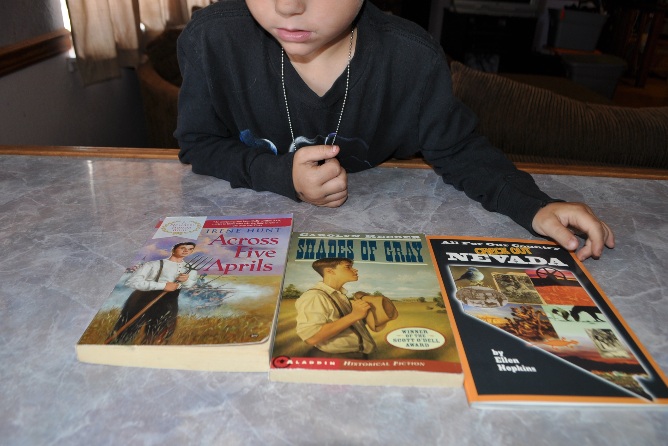
Cody age 9 - 4th Grade - State History - We live in Nevada, so that means all about Nevada
Tyler age 10 - 5th Grade - US History

We will use a mix of resources - a few novels that follow the time period, internet, encyclopedia, research, etc.  Especially with Tyler and Cody, I want them to work on self-learning and researching skills.

Science


Will also be a mix of resources, but this will be my main text and go to resource for the units we work on.

Handwriting
Almost completely forgot this!  So I am using some OLD pics of Cody with our choice of Handwriting Without Tears.  We have used this for years and we all love it!  The boys love using the chalkboard to "wet, dry, try".


I am writing this post as part of the Not Back To School Hop.  If you would like to share your curriculum plans, be sure to hop along!  I would love to see what others are using!

Not Back to School Blog Hop

Enhanced by Zemanta

Saturday, July 30, 2011

i.am.FIRST: Science is Rock & Roll ABC Special


All of my boys are big science fans.  They are also big music fans.  That is why I know our tv will be set to ABC for their i.am.FIRST: Science is Rock & Roll special on August 14th from 7 to 8 PM.  The show features will.i.am from the Black Eyed Peas who teamed up with inventor/FIRST founder Dean Kamen to put together this groundbreaking, one-hour special promoting education, science and technology.

The show will feature musical performances by by The Black Eyed Peas and Willow Smith along with special appearances by such celebrities as Justin Bieber, Jack Black, Bono, Miranda Cosgrove, Miley Cyrus, Josh Duhamel, Willow Smith, Britney Spears, Snoop Dogg, Justin Timberlake, and  Steven Tyler.

In addition to the all star perormers, the program also documents the challenges that the country’s best and brightest students faced in the FIRST Regional Competitions leading up to and culminating in the international Championship.


You can read more about this ABC special here.

And if you and your kiddos are looking for some science fun and experiments to do right now, check out all of the resources I've posted here.


Enhanced by Zemanta

Saturday, July 23, 2011

Free Math and Science Printable Posters


I found these great free printable math and science posters for your older homeschooling kiddos.  You can print them out, stick them in a sheet protector and have your child stick them in their binder/notebook/ or lapbook they are completing.

Saturday, July 16, 2011

Ice Cream Lesson Plan


In honor of National Ice Cream Month (July) and National Ice Cream Day (July 17th), I thought I'd share a few ice cream related learning activities for your homeschooling use!

Handwriting

I is for Ice-Cream!  Practice writing the letter I here.

Math

You Scream For Ice- Cream Math Journal Topic


Try your hand at the word problems on this worksheet:  scrumptious ice cream math

Science
Learn about the Chemistry of Ice Cream with this fun science activity.

Writing
How do you make ice cream?  Write about it with this writing prompt.

Wednesday, July 6, 2011

Science Labs For Your Older Kiddos


One of the problems with homeschooling (especially older kiddos), is trying to figure out how to do fun science experiments without spending a ton of money on supplies.  That's why I love The Lab of Mr. Q. He has a monthly newsletter that gives you great, easy, inexpensive science experiments that you can do at home with your homeschoolers.  The boys and are I going to try out the lab above tomorrow here, but you can also access more newsletters here.

Sunday, May 1, 2011

Baby Chicks Lesson Plan


Baby chicks are a great way to get your homeschool kiddos involved in science.  They can learn about life cycles, debate the age old question - which came first? The chicken or the egg? 

 In the incubator. After a hen mates with a rooster, she lays fertilized eggs. In 21 days, these eggs will hatch if they are kept warm by the hen’s body or an incubator. Find out what happens inside the shell while the embryo is growing into a chick. If possible, obtain an incubator and fertilized eggs to see what happens next!


They’re hatching! When the chick is ready to hatch, it pokes a hole in the sac, sticks its head through the shell membrane, and breathes in the air space. You can hear the chicks peeping inside their shells. Baby chickens use "egg teeth" to peck their way out of their shells. When the chicks hatch, they are wet and tired. Soon they dry and turn into balls of fluff!


Here are some other resouces for learning about chickens!


I see the egg emergent reader

Chicken Litte Reader's Theater


Sunday, February 13, 2011

Live Owl Cam


The boys and I have become quite addicted to watching the live owl cam here.  Mama owl, Sydney is waiting on the arrival of her new baby owls.  I wanted to share the link with you now, and I am working on some owl resources for my kiddos that I will share as soon as I put them up!

Handwriting

Practice writing the word owl with this handwriting worksheet.

Math

Practice multiplication with this owl themed worksheet.

Art


Your kiddos will love making this adorable owl craft.

Reading

Read Owl Moon by Jane Yolen, then answer the reading comprehension questions and math journal questions here.